
KYLE SCHECK
PHOTOGRAPHER
KAITRISS DEGROFT
STAFF WRITER
11/17/2025
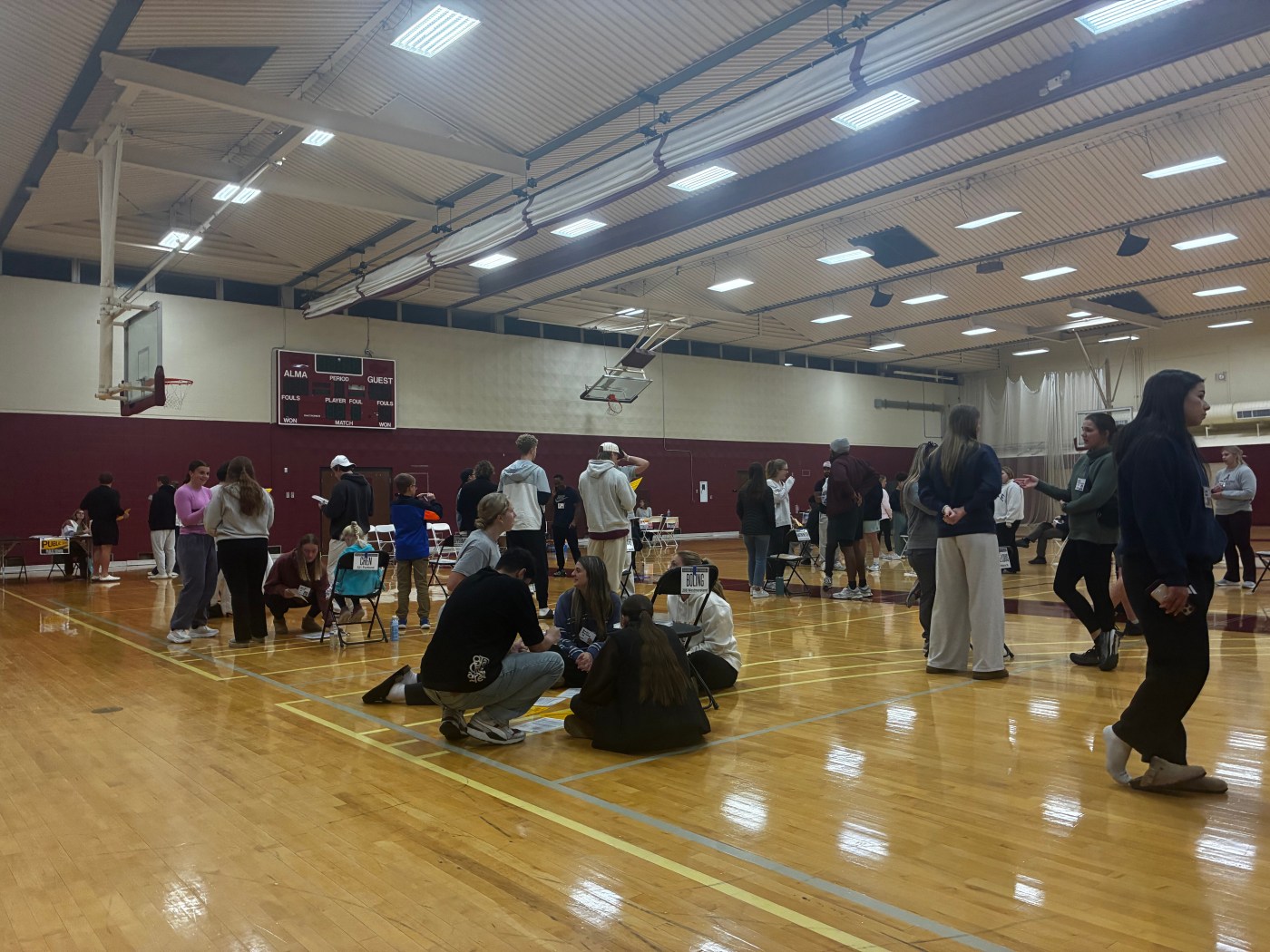
On Wednesday, November 12th, the nursing department at Alma College hosted the poverty simulation, an event for students to join and engage in what it is like to manage the challenges, barriers, and constant stressors faced by those living in poverty.
Participants assume the roles of individuals from low-income families within a simulated community setting. Participants are challenged to manage limited financial resources to meet essential needs across four 15-minute simulated weeks.
The staff emphasises to participants that this is not a game. The program is designed to help participants better understand the everyday realities of families living in poverty or those considered ALICE, meaning asset-limited, income-constrained, and employed.
Angela Griffin, an instructor of nursing at Alma College, shares her thoughts on how the poverty simulation benefits participants.
“Participants gain a greater awareness of the systemic barriers that make escaping poverty extremely difficult. These insights often lead participants to reflect on how policies, community resources, and social attitudes impact real lives,” said Griffen.
Her work continues that goal by fostering understanding and connection between the campus and the broader themes of the simulation. The simulation not only raises awareness but also encourages ongoing conversations about advocacy, empathy, and responsibility within the healthcare field and beyond.
“In healthcare, we often care for individuals who face significant social and economic challenges. Our goal is to strengthen their ability to provide compassionate, holistic care and to advocate for patients beyond the clinical setting,” said Griffen.
Many of the students demonstrated similar reflections in relation to the poverty simulation. It is evident that the simulation had an overall positive impact on their perspectives.
Ella Cusack (‘26) explains the poverty simulation’s benefits from a planning committee viewpoint.
“I personally feel like the poverty simulation is beneficial because it demonstrates community. Multiple groups come together to make the event possible, which is a really beautiful example of community action,” said Cusack.
The members of the campus are not the only contributors to the poverty simulation; many important roles throughout the Alma community come together in order to provide the poverty simulation.
“It is incredibly meaningful to see the partnership between students, staff, faculty, and community members that makes the event possible. I always walk away with a new connection and a new understanding of poverty,” said Cusack.
Many of the participants, staff, and volunteers reflect on how the event played out compared to previous years and being in different roles.
“The poverty sim went very well! It was really rewarding to see everyone who showed up to volunteer and participate. This year, I was on the planning committee with Mikaylyn Kennedy (‘26), Ella Mondroski (‘26), and Madie Carandang (‘26). It is a very different experience planning the event and looking at it critically as a volunteer versus being a participant,” said Cusack.
Behind the scenes, the poverty simulation was the result of careful preparation and teamwork. Each volunteer and supporter contributed to creating an environment that encouraged learning, empathy, and reflection.
 The Almanian: News
Leave a Reply