
ALEX GILLIES
GRAPHIC DESIGNER
DARCY DAENZER
LAYOUT EDITOR
4/1/2024
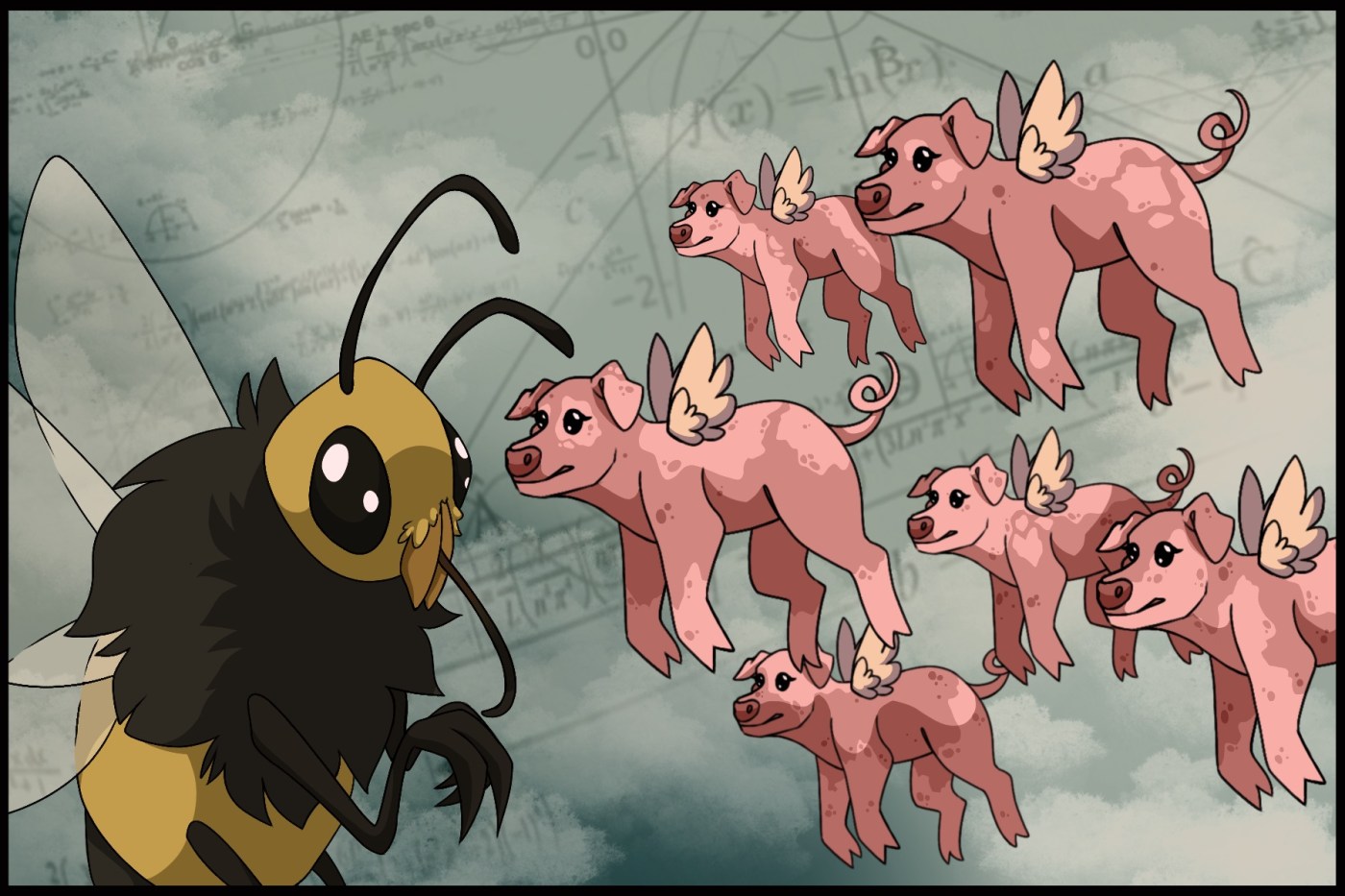
On March 25, the Association for the Flying Of Once-Flightless Livestock (AFOOL) announced that pigs have finally gained the ability to fly. What has been the work of countless physicists and flightless animal enthusiasts has become a reality, giving these traditionally confined animals the freedom they have desired for so long.
Physicists have been working tirelessly for the past couple of decades trying to give these poor pigs the chance to see the sky up close and personal, and they finally cracked the case after looking at the humble bee.
It has long been known that the bee defies the laws of mathematics due to its tiny wings and its proportionately big, fuzzy body. In the 1990s, it was discovered that bees have “tiny tornado-like airflows that form on the leading edges of their wings, known as leading-edge vortices (LEVs),” said Timothy Revell of New Scientist.
These LEVs, instead of giving the bee extra lift as was previously thought, enable the wing of the bee to fly “at a much higher angle of attack without stalling,” said Mostafa Nabawy in an interview with Revell.
“The swirls of air at the edge of a bee’s wing enable the insect to angle its wing more sharply toward the sky, improving the flow of air over the wing. It’s this higher wing angle that gives bees, fruit flies and even hummingbirds enough lift to fly,” said Revell.
Knowing the physics behind bees being able to fly had larger implications, long before scientists helped the pig learn how to fly; “[The] new work could also ‘have an important impact on the development of fans, turbines, or miniature flying vehicles for deliveries, surveillance or search-and-rescue tasks,’” said Richard Bomphrey of Royal Veterinary College.
What scientists didn’t know when this article was published in 2017 was that this information would help with the flight of pigs as well.
While it has been known that pigs have short, coarse hair covering their body, only recently have scientists begun shaping this hair into artificial wings; all it took was a hairbrush and some Gorilla Glue. While the easiest part of the task was shaping the wings, the hardest was convincing the pigs that they could now fly and unlearning the criticism of all those who came before them saying they would never be able to.
It took grueling hours of gently guiding pigs off of ramps to land in a bed of soft pillows below; simulating flight by lifting the pigs in the air, blowing a fan in their faces and having a human helper manually flap their wings; and exposing them to the flight of other gravity-defying animals such as the bee and the hummingbird.
After the first pig took flight in Kitty Hawk, North Carolina, pigs all over the world began to fly for themselves. So many pigs have taken to the air that a new term has been coined: “pig sky.”
Many Alma students have enjoyed seeing pigs flying around campus. “It’s been such a great way to start my morning. I love seeing those little pink things flying through the sky every day. I’m just so proud of them as a species,” said Amelia Price (‘24).
Perhaps with the flight of pigs, other flightless animals will soon follow suit, like penguins, ostriches, elephants or even whales. “It’s the first step in the right direction for flightless animals. I hope cats are next,” said Price.
So don’t be surprised if you see pigs flying in Alma or your neighborhood town – they are likely enjoying their freedom from the pens in which they have for so long been held.
Happy April Fools’ Day!
 The Almanian: News
Leave a Reply