
KYLE SCHECK
PHOTOGRAPHER
NAYONIKAA SINGHAAL
STAFF WRITER
2/9/2026
A wave of extreme winter weather has swept across the United States in recent weeks, stretching from the Deep South to New England. More than 150 million Americans have been impacted by snow, ice, and dangerously low wind chills according to the National Oceanic and Atmospheric Administration (NOAA) calculations.
Although Michigan is no stranger to winter, the intensity and duration of the cold have created challenges across the state, including here in Alma. The national attention focuses on the storms while scientists and policymakers are debating how climate change and government preparedness intersect with events like these.
Dr. Murray Borello, an environmental science professor at Alma College, explained that extreme cold events do not contradict global warming; instead, they can be a consequence of it. The more immediate cause of the current cold spell is linked to the polar vortex which is a high-altitude circulation of frigid air that usually remains stable over the Arctic. altitude circulation of frigid air that usually remains stable over the arctic.
“When we have a stable climate, we observe a circulation pattern to the atmosphere that is distinctly stratified, but because of the interaction with warm air rising higher in the atmosphere, the polar vortex destabilizes and creates a dip and ‘wobble.’ This brings extremely cold air down to latitudes that don’t normally experience them,” said Borello.
As the storms continue, questions are being raised about whether federal and state policies are adequate for a climate that is no longer behaving like the past. Borello pointed the need for updating building codes in southern states where homes are often not insulated for cold weather and installing emergency management plans that incorporate climate models.
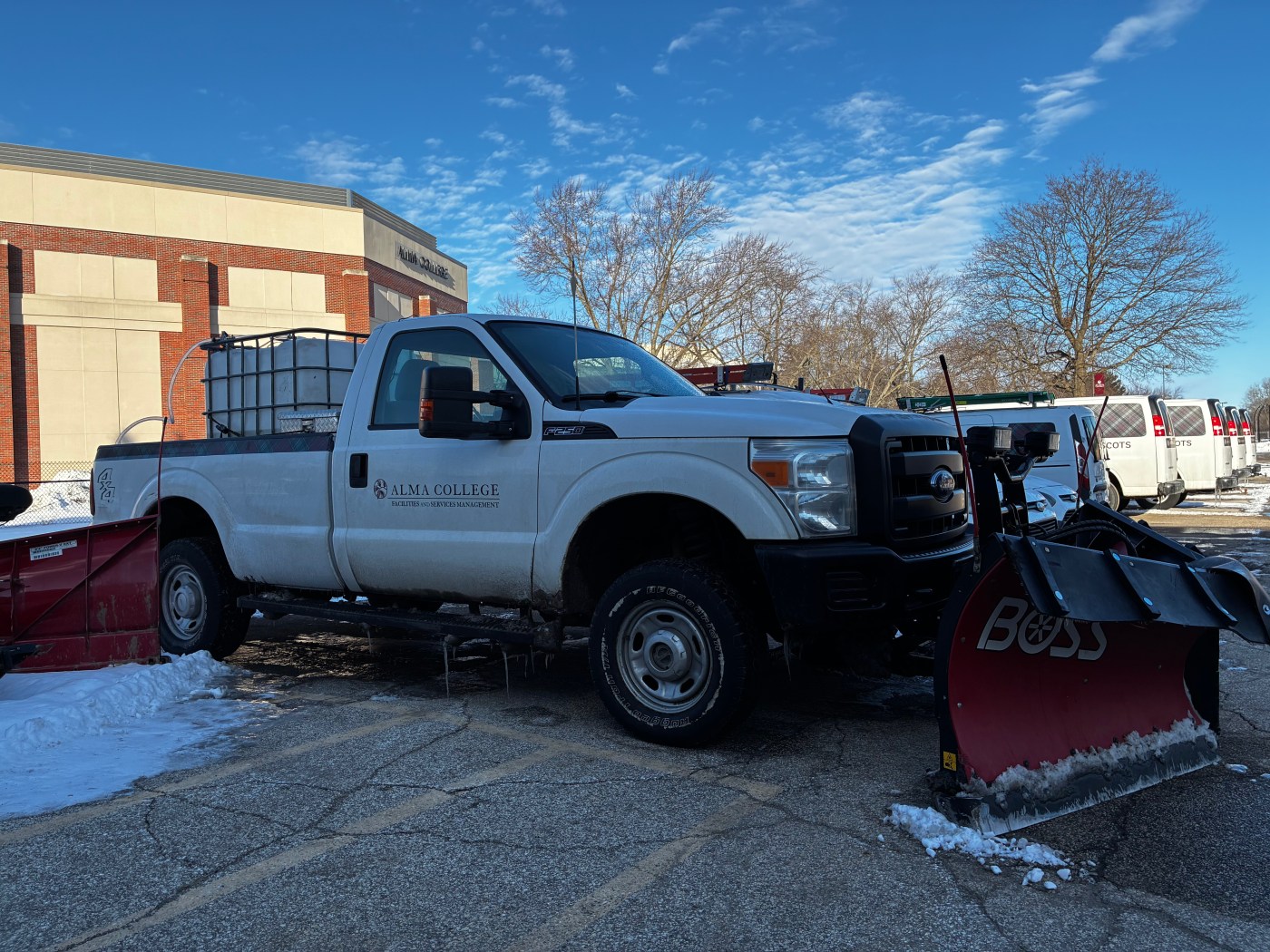
Here in Alma, the effects of the cold have been felt most visibly through infrastructure strain. At a recent Student Congress meeting, Director of Facilities, Ryan Stoudt, reported that the college handles between 1,500 and 1,600 work orders per month, supported by eight technicians, seven grounds workers and the custodial staff. With roughly a hundred miles of piping across campus, identifying frozen or burst pipes is a major challenge.
This semester alone, the college has used 92 tons of salt, which is nearly double the amount purchased in advance. Several buildings have experienced damage, including Brazell Hall, where a frozen pipe burst in a second-floor study room, and Carey/Bonbright, where approximately 5,500 gallons of water flooded the basement and damaged the fire panel. Repairs are ongoing, with officers monitoring the building around the clock until the new system is installed.
Students have been adjusting to the disruptions as well–both dangerous walking conditions and water damage.
“This campus is icy and everyone’s slipping, it feels like winter just keeps getting more intense every year,” said Annie Singh (’26).
Students have been adjusting to the disruptions as well.
“I was meeting when my residents called me to tell me that our kitchen is flooding, it’s stressful, but the facilities team has been working nonstop,” said Madesyn Wheaton (‘27), Resident Assistant of Bonbright hall.
As the storms continue across the country, Alma’s experience reflects a larger national conversation where extreme cold is no longer just a seasonal inconvenience but part of a shifting climate that demands new forms of preparation.
 The Almanian: News
Leave a Reply