
LINDSEY ZARKA
GRAPHIC DESIGNER
KATELYN THOMAS
STAFF WRITER
3/24/2025
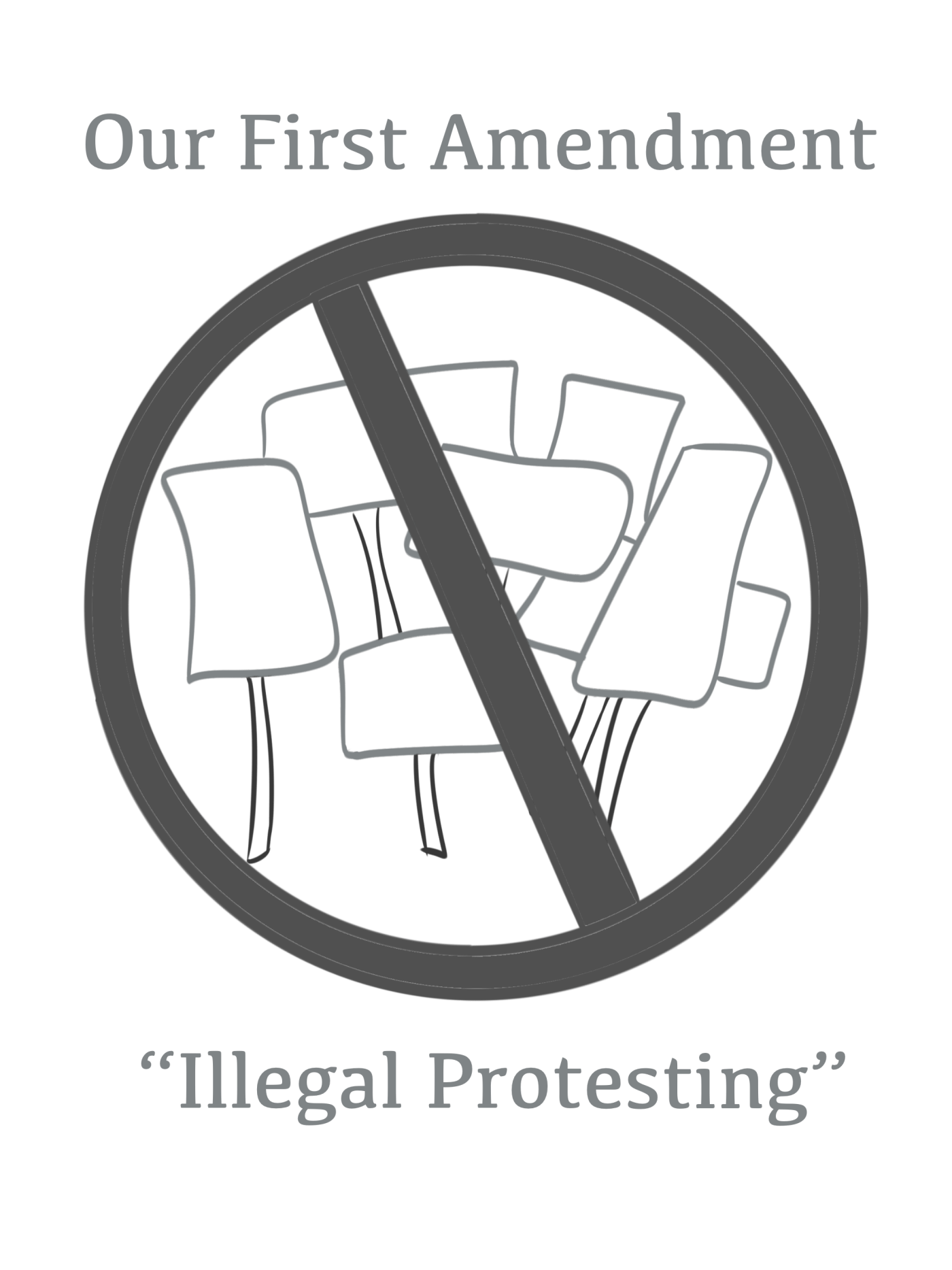
After almost a year since protests against Israel’s war in Gaza swept college campuses nationwide, President Donald Trump recently stated he would cut funding to universities who support “illegal” protests and would deport international students who participated in said protests.
Around this time last year, Columbia University drew national attention with their large-scale protest. Students pitched tents and refused to move after the college President, Minouche Shafik, stated they were trespassing.
As word spread through campus about the statement Shafik made, it sparked outrage and more students pitched tents. The protest severity developed over the following days, as the New York Police Department was sent in by President Shafik. The NYPD arrested around a hundred Columbia students.
The US Department of Education made a statement about revising Columbia’s federal contract regarding the ongoing investigation about the Title VI violations relating to antisemitism on campus. Title VI is a federal law that bans discrimination based on gender, sex, religion, ethnicity or ancestry.
Protests, even on college campuses, are only “illegal” or “unlawful” when they become or will possibly become violent. They are also deemed unlawful when and if protesters are violating other laws.
If protests are on private property, there has to be permission granted by the property owner for it to be deemed lawful. If protestors begin harassing others or blocking bystanders from sidewalks or public spaces this can also be deemed unlawful.
Alma makes it their mission to develop well-rounded graduates who can problem solve and think critically. In the classroom, professors motivate students to see the other side and think outside of the box.
“The point of college is to undertake conceptual analysis and historically derived specification (the presentation of ‘facts’) in order to transform your sense of how the world works,” said Ben Taylor, Assistant Professor of Political Science.
College campuses must address any illegal protests that are held on campus, but this cannot infringe on their First Amendment rights. Many colleges, including Alma, encourage students to use their voices and be forward thinkers.
“We are not merely responsible for the world; we are the world. In changing ourselves, just as in changing what’s around us, we change the world. Again, this makes each of us deeply responsible for the world that is emerging,” said Taylor.
Alma has several politically active clubs on campus. Some of which are Young Democratic Socialists of America (YDSA) and Leaders for Environmental Awareness Protection and Sustainability (LEAPS), who protested at the State Capitol on March 7 for Stand Up for Science.
These clubs along with many others have received both financial and communal endorsement, giving students the opportunity to explore new ideas and use their voice to influence change.
“The way we act is only either more or less oriented toward positive transformation. The more we know, the better we can orient our actions toward the multiplication of positive impacts,” said Taylor.
“The important question right now isn’t about encouraging students to speak out, though they should if they feel moved to do so. It’s a question of refusing to cave to any pressure that should arise, from whatever quarters, to punish students for doing so,” said Taylor.
 The Almanian: News
Leave a Reply